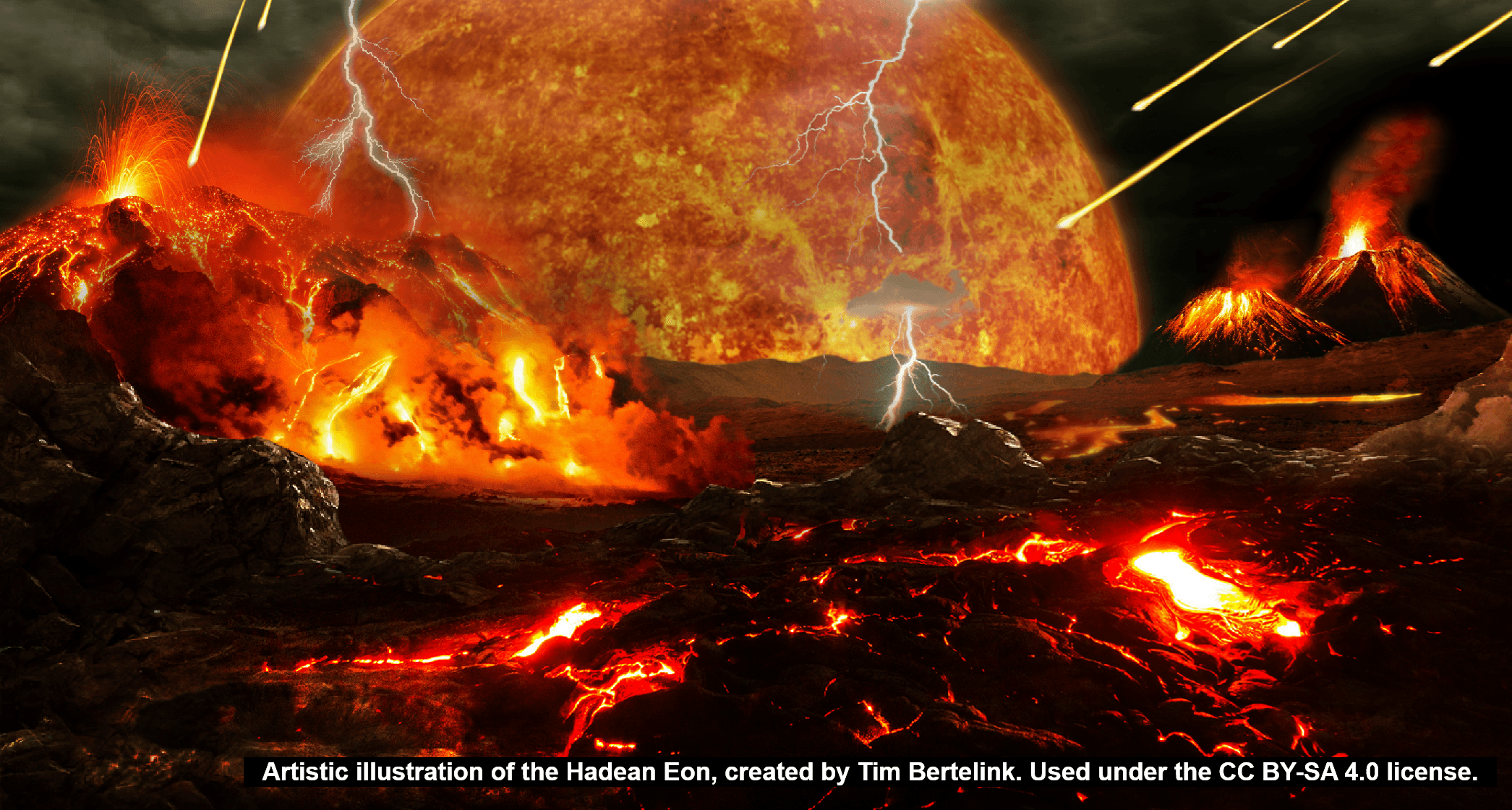
The story of Earth did not begin with the calm, deep blue landscapes we see today. If you had a time machine and traveled back 4.6 billion years, you would not find anything you recognize. What lay before you was an “age of chaos,” where the sky was constantly burning, the ground beneath your feet was molten lava, and massive asteroids were relentlessly crashing down upon you.
Scientists refer to this approximately first 500–800 million-year period of Earth as the Hadean Eon, inspired by Hades, the god of the underworld in Greek mythology.
Join us as we explore this smoky and fiery birth story of our planet. In this article, we will examine step by step how Earth formed, how the Moon came into being, when the first oceans appeared, and how all of these processes might be connected to the origin of life.
1. When Did the Hadean Begin, and When Did It End?
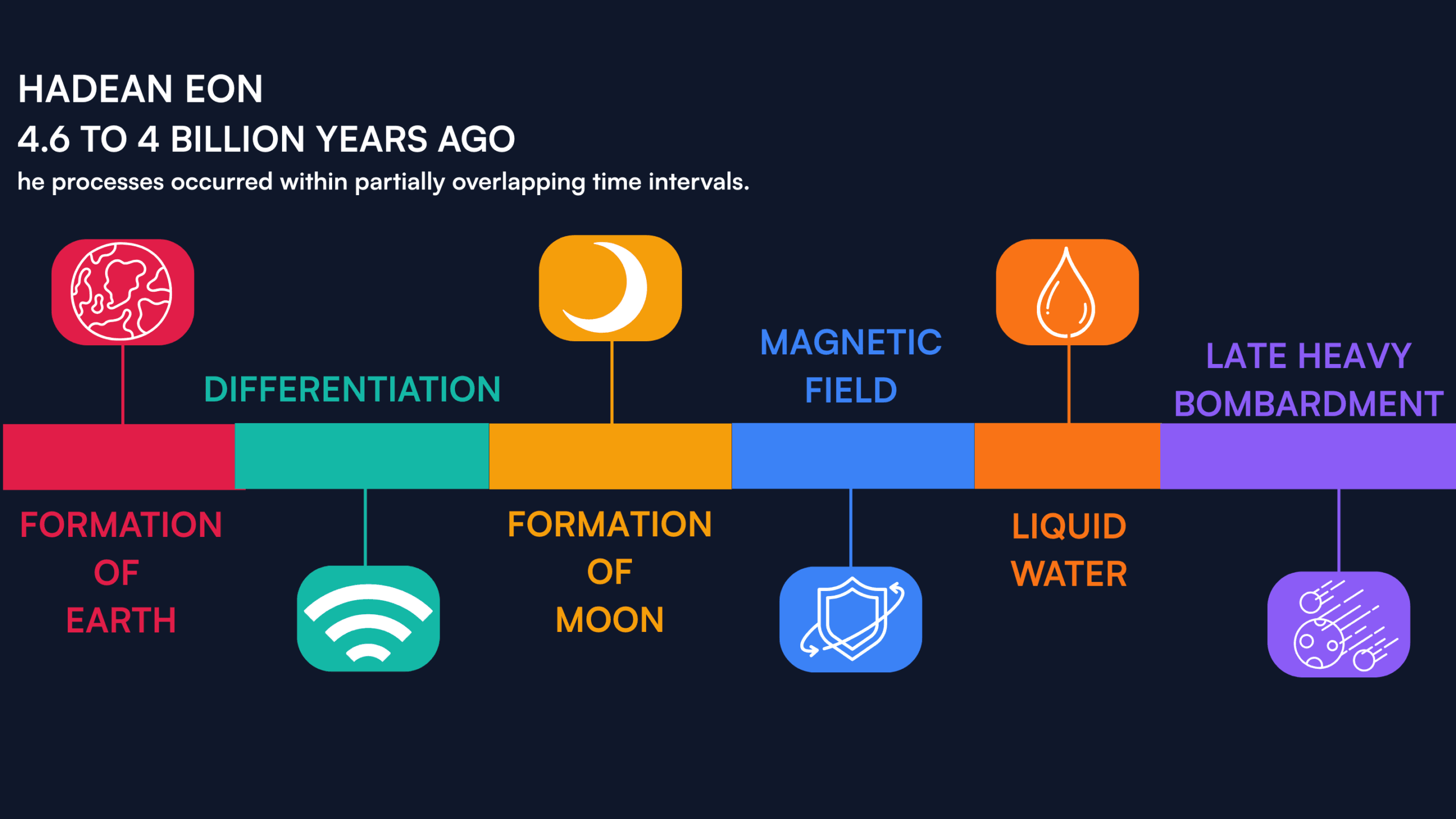
The Hadean Eon begins with the formation of Earth, approximately 4.56 to 4.6 billion years ago. This period lasted until about 4.0 to 3.8 billion years ago, when the first permanent rock records appeared and the Archean Eon began.
There is an important detail here: there is almost no direct rock record from the Hadean. In other words, we do not have intact Earth rocks preserved from that period. So, how do we know about this era?
The answer lies in indirect evidence. We examine meteorites that are the same age as Earth. Since we lack preserved Earth rocks from that era, we turn to these meteorites. We analyze individual mineral crystals and examine isotope ratios. For this reason, Hadean geology is largely based on inference. In a way, we are trying to reconstruct the oldest chapter of the planet from the remaining clues.
2. From a Cloud of Dust to a Fireball: How Did Earth Form?
Everything began in a massive cosmic construction site. The Sun had just been born, and there was a vast disk of gas and dust rotating around it. The Solar System formed from this disk surrounding the young Sun. The small particles in this disk grew by colliding with one another—a process called accretion (growth by accumulation). You can think of it like a snowball: tiny dust grains collided and stuck together, growing into pebbles, which then turned into massive rocks. Eventually, these rocks grew so large that celestial bodies with their own gravity emerged.
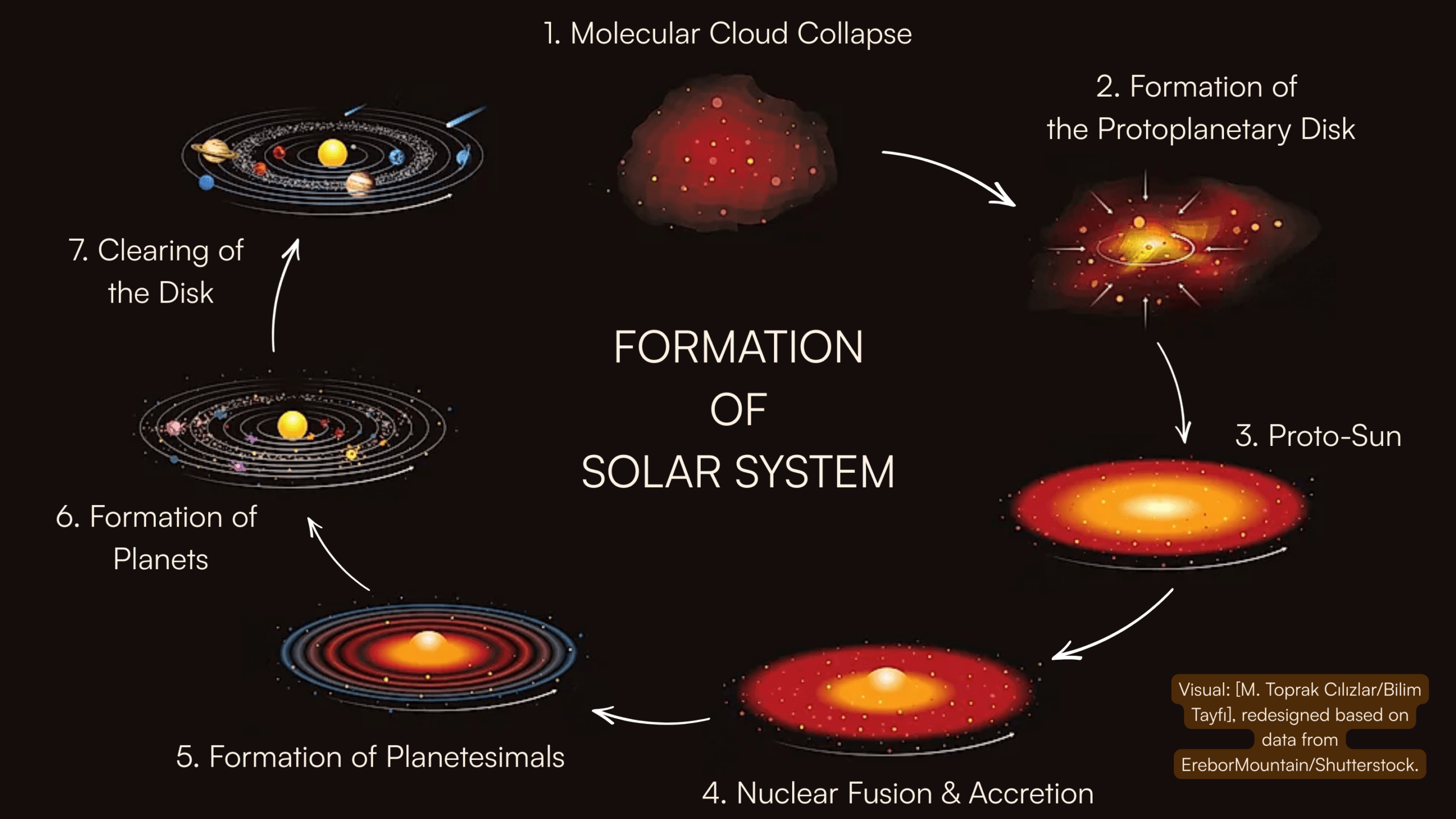
As Earth grew, the energy from collisions and the decay of radioactive elements nearly completely melted the planet. The entire surface was a boiling ocean of lava, hundreds of kilometers deep. There was no solid landmass; there was nowhere you could stand.
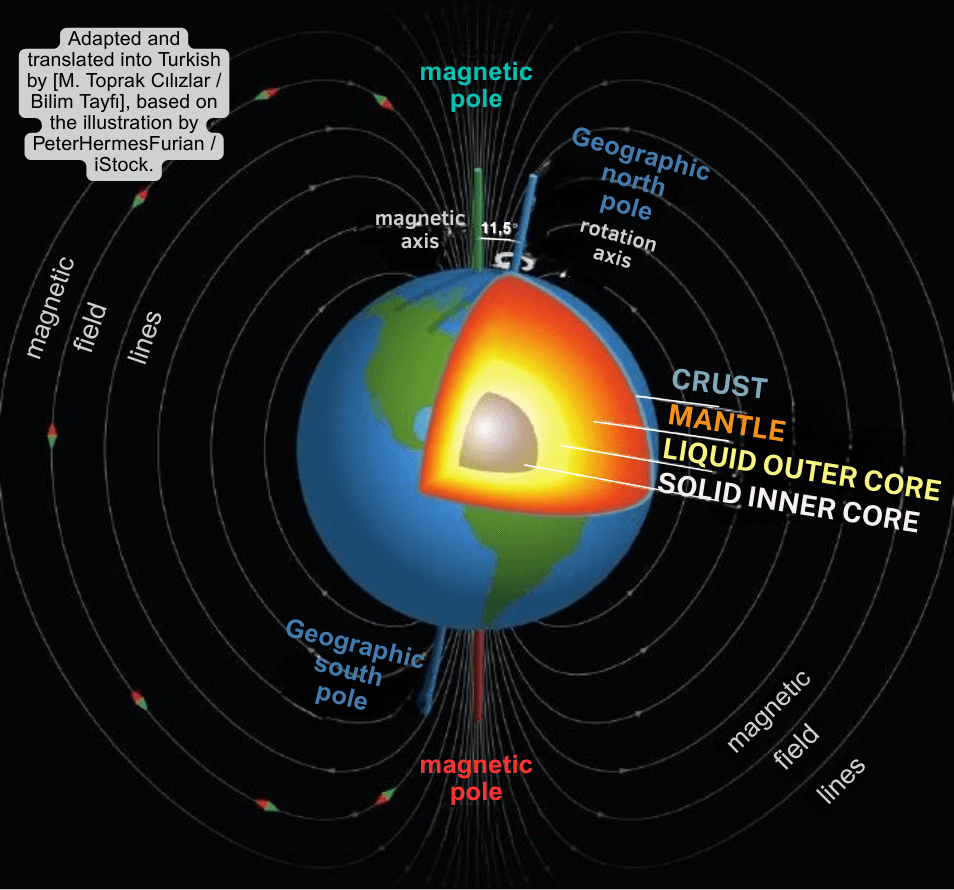
In this molten young Earth, heavy elements sank toward the center and formed the core. Just like oil and water separating, the lighter rocky materials remained near the surface and formed the mantle. Thus, heavy metals such as iron and nickel stayed at the center, while lighter silicate minerals remained in the upper layers. This process is called differentiation (layering). As a result, a layered structure emerged. From the center outward: Core, Mantle, and Crust… The internal structure of today’s Earth was shaped during this early period.
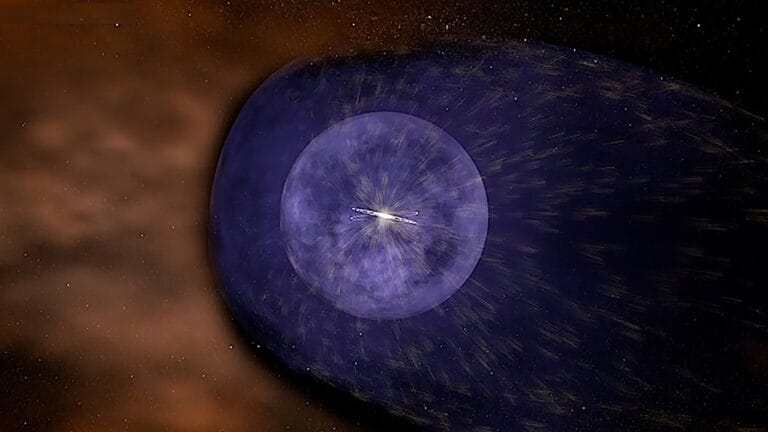
Most importantly, this process did not merely result in layering. The motion of the molten iron core eventually generated Earth’s magnetic field. This invisible shield prevented solar winds from stripping the atmosphere into space. If this magnetic protection had not formed, Earth might have lost much of its atmosphere, much like Mars.
3. The Birth of the Moon: The Giant Impact
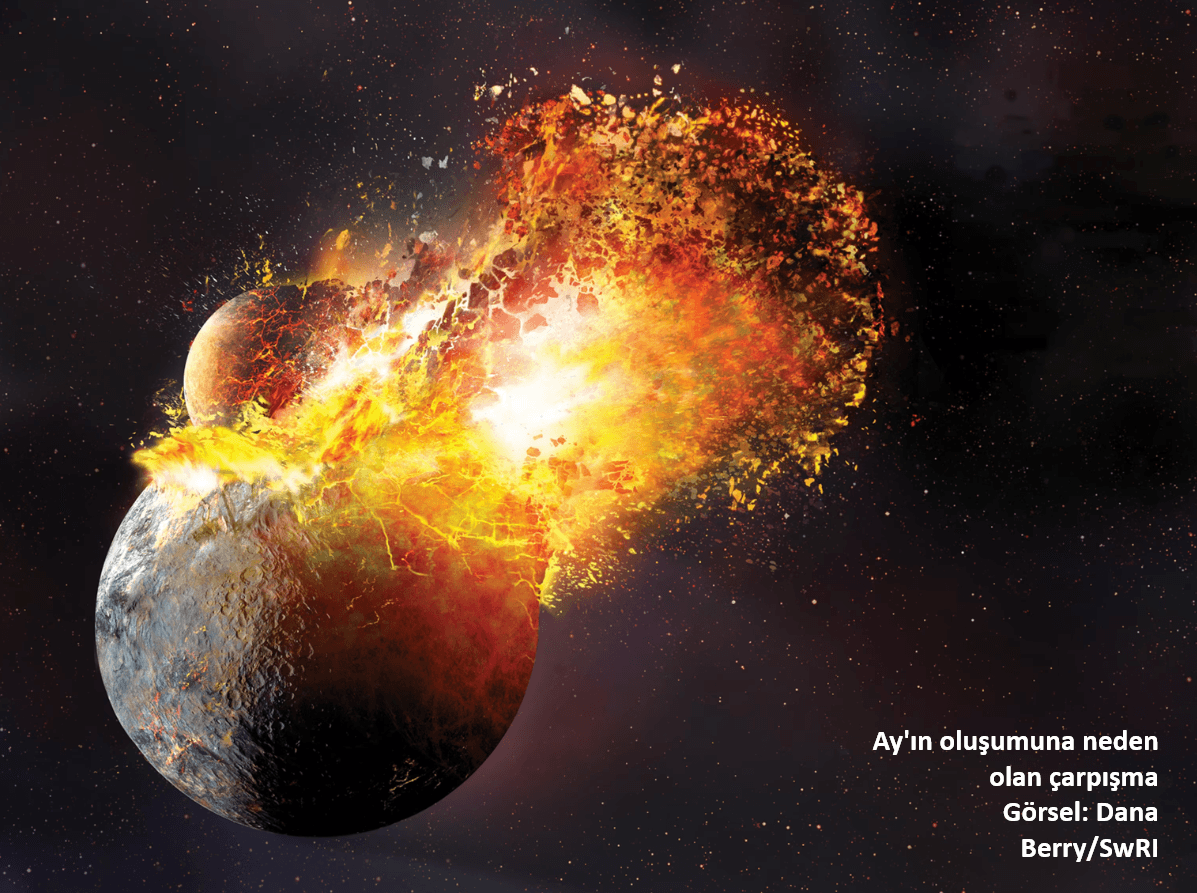
The most dramatic event of the Hadean was the formation of the Moon. Approximately 30 to 100 million years after Earth formed, a Mars-sized protoplanet named Theia collided with Earth. The impact was so violent that a significant portion of Earth’s outer layers was ejected into space. This debris gradually coalesced to form the Moon.
The consequences of this collision were immense: a global magma ocean re-formed, the primordial atmosphere was largely lost, Earth’s rotation rate changed, and its axial tilt was established.
An interesting detail: At that time, the Moon was much closer to Earth than it is today! The Moon appeared colossal in the sky, and this proximity caused towering tidal waves reaching kilometers in height. Moreover, Earth was rotating so rapidly on its axis that a Hadean day lasted only 5–6 hours!
4. Zircons: Nature’s Black Box
For a long time, Hadean Earth was thought to have been an entirely molten planet. However, small but extremely durable minerals called zircons changed this picture. These crystals, smaller than a grain of sand, are the sole surviving witnesses from that chaotic age, preserving chemical information from billions of years ago within them. For this reason, it would not be wrong to call them “Nature’s black boxes.” If they did not exist, we would still perceive the Hadean as nothing more than a “ball of fire.”
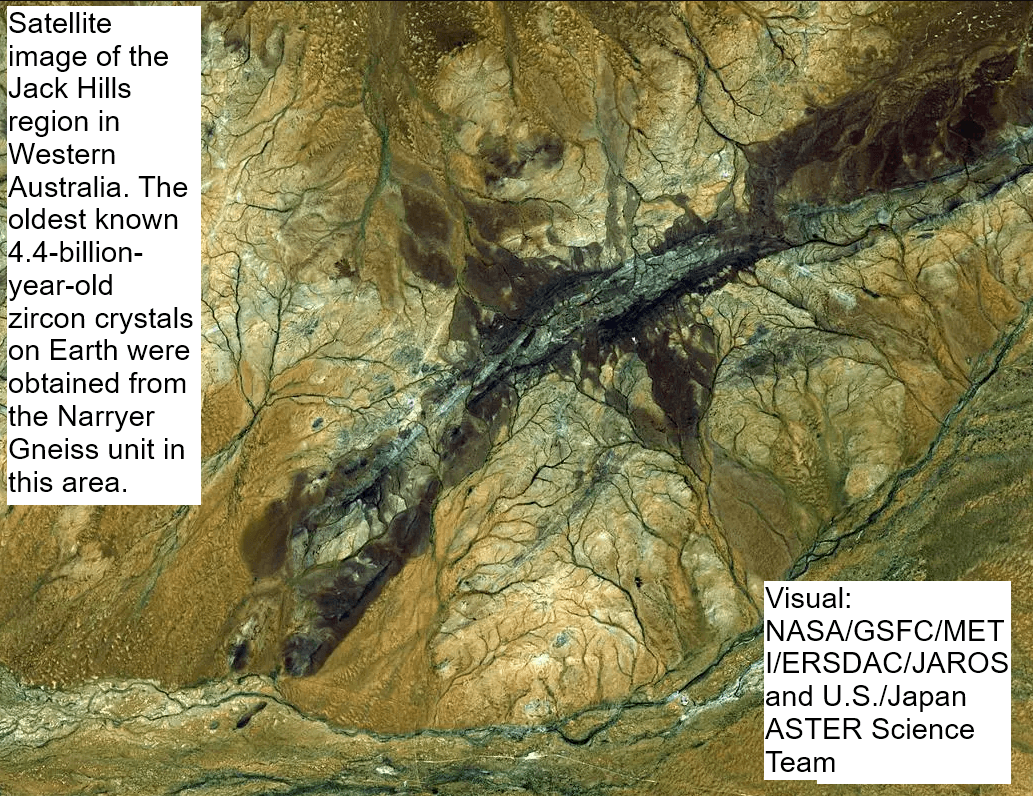
Zircons dating back 4.4 billion years, found in Western Australia, show that Earth cooled more rapidly during that period than previously thought. The oxygen isotope ratios within them reveal that these crystals derived from rocks that had interacted with liquid water.
What does this mean?
It means that as early as 4.4 billion years ago, a solid crust already existed and liquid water was likely present. In other words, the Hadean was not merely a ball of fire; it was a period when clouds condensed, rains began, and the first oceans lapped against the shores. This model is known as the “Cool Early Earth” hypothesis.
5. The Atmosphere and the “Faint Young Sun” Paradox
Earth’s first atmosphere likely consisted of hydrogen (H2) and helium (He). However, these light gases quickly escaped into space. Later, a second atmosphere formed through volcanic outgassing and volatile materials delivered by impacting celestial bodies. This atmosphere was devoid of oxygen. It contained high levels of carbon dioxide (CO2), nitrogen (N2), and water vapor (H2O). Nitrogen, the primary component of our atmosphere today, helps keep water in liquid form by regulating pressure. In other words, nitrogen plays a critical role in the planet’s habitability. The abundance of reducing gases—such as methane (CH4) and ammonia (NH3) (chemically reactive, electron-donating gases)—remains a subject of debate and was likely not as high as previously thought.
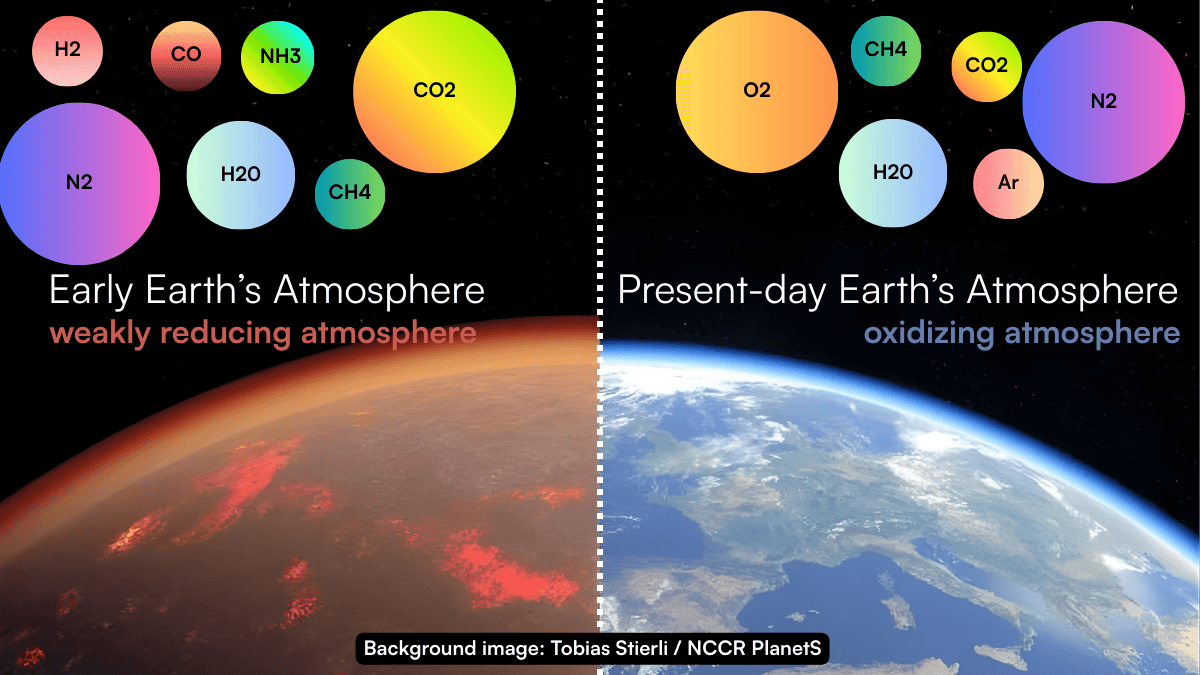
As Earth cooled, the water vapor (H₂O) in the atmosphere condensed, and the first oceans formed. The source of the water likely did not come from a single origin. Both volcanic outgassing and water-rich meteorites may have delivered water to Earth.
There is an interesting puzzle here: the Faint Young Sun Paradox. At that time, the Sun had only about 70% of its present luminosity. Under such conditions, the planet should have been a frozen world. However, the high concentration of carbon dioxide (CO₂) in the atmosphere created a strong greenhouse effect, keeping our planet warm and allowing water to remain in liquid form.
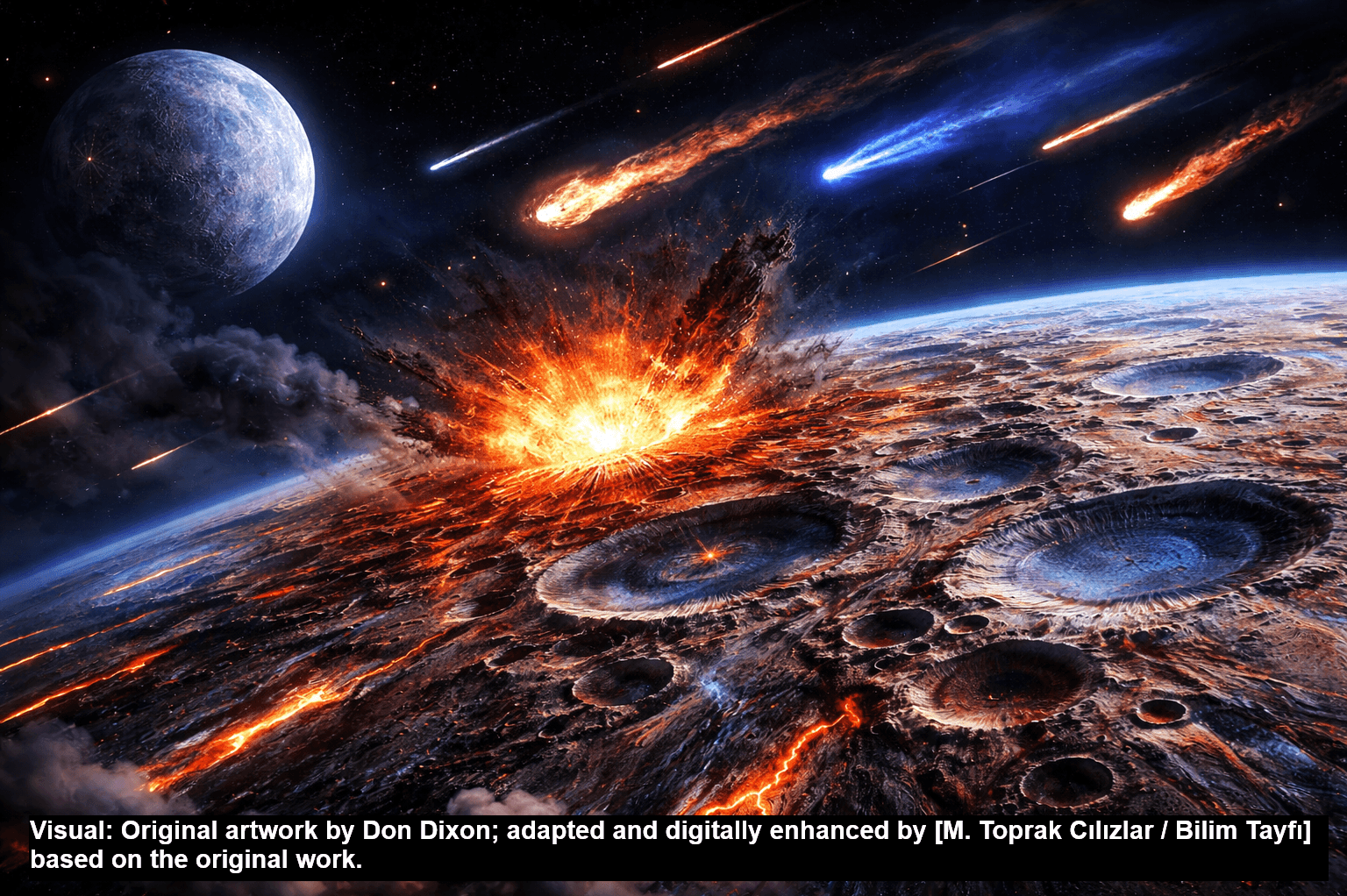
Toward the end of the Hadean, approximately 4.1 to 3.8 billion years ago, the inner Solar System was subjected to an intense barrage of asteroids and comets. This period is known as the Late Heavy Bombardment (LHB). Orbital shifts of the giant planets, especially Jupiter and Saturn, may have flung millions of asteroids into the inner Solar System. Most of the large craters on the Moon’s surface date back to this period. However, it remains a subject of debate whether this event was a single sudden catastrophe or a prolonged period of gradually declining impacts.
This bombardment may have obliterated everything that had formed up to that point and may even have vaporized the oceans.
So, what happened to life?
The impact of this event on life is still debated: it may have delayed the emergence of life or even wiped out the early biosphere several times. Scientists call this “Impact Frustration.” Conversely, these impacts might have actually delivered essential water and organic molecules to our planet. At this stage, it is impossible to say for sure.
7. Did Life Begin in the Hadean?
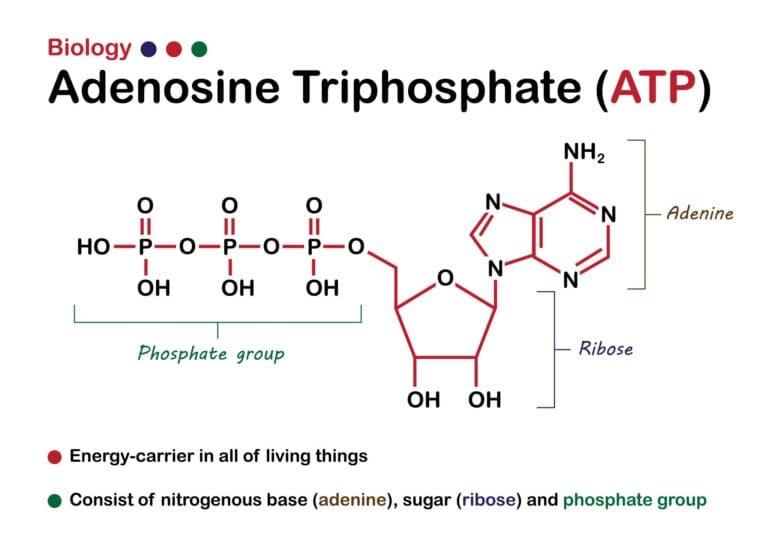
At the end of the Hadean, approximately 4.0 to 3.8 billion years ago, the Archean Eon begins. While the oldest traces of microbial life date back to the Archean, the foundations of life may well have been laid during the Hadean. Life requires three essential ingredients: liquid water, organic molecules, and an energy source. On Hadean Earth, all of these were potentially present.
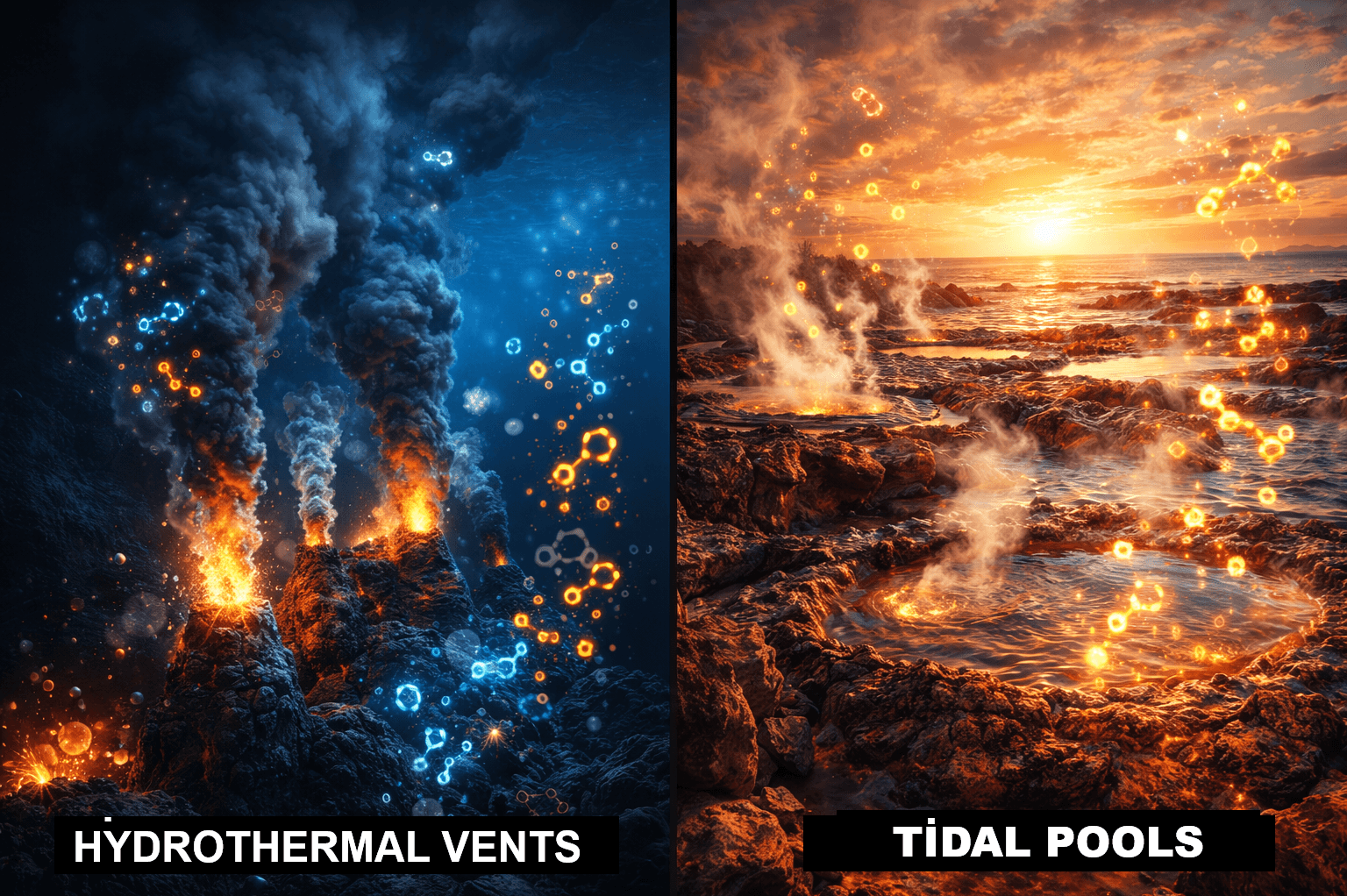
Hydrothermal vents on the ocean floor may have acted as natural reactors, providing metal ions and chemical energy. Alternatively, the evaporation and refilling of tidal pools may have helped concentrate organic molecules, setting the stage for the first cells.
In other words, the oceans at the end of the Hadean were not just water; they were more like a hot, mineral-rich, and dark “prebiotic soup” constantly sparked by lightning. For this reason, the Hadean was not only a period of destruction but also a vital phase of chemical preparation.
Planet or Laboratory?
To view the Hadean merely as a period of catastrophe would be incomplete. It was a threshold where planetary physics, chemistry, and cosmic events converged. If even one of these early conditions had been different, biology as we know it today might never have existed. Perhaps life would have followed an entirely different chemical pathway beyond our imagination; perhaps the “intelligent being” reading these lines right now would be a representative of a silicon-based life form instead of a carbon-based one.
In this sense, the Hadean Eon is the story of Earth’s transformation from a fireball into an ocean-covered planet. It is the era when the Moon was born, when the core and crust were forged, when the atmosphere took shape, and perhaps when the chemical seeds of life were sown.
If we are able to read this today, we owe it to the few tiny zircon crystals that survived those lava oceans 4.4 billion years ago, and to the first droplets of water that filled the seas. The Hadean was not merely a hellish phase; it was Earth’s primordial laboratory. It was a stage where order emerged from chaos, oceans from molten rock, and living biology from lifeless chemistry.
The story of a planet is, in essence, the story of a laboratory. As the Hadean drew to a close and the Archean began, the stage was finally set for the greatest show on Earth: life.