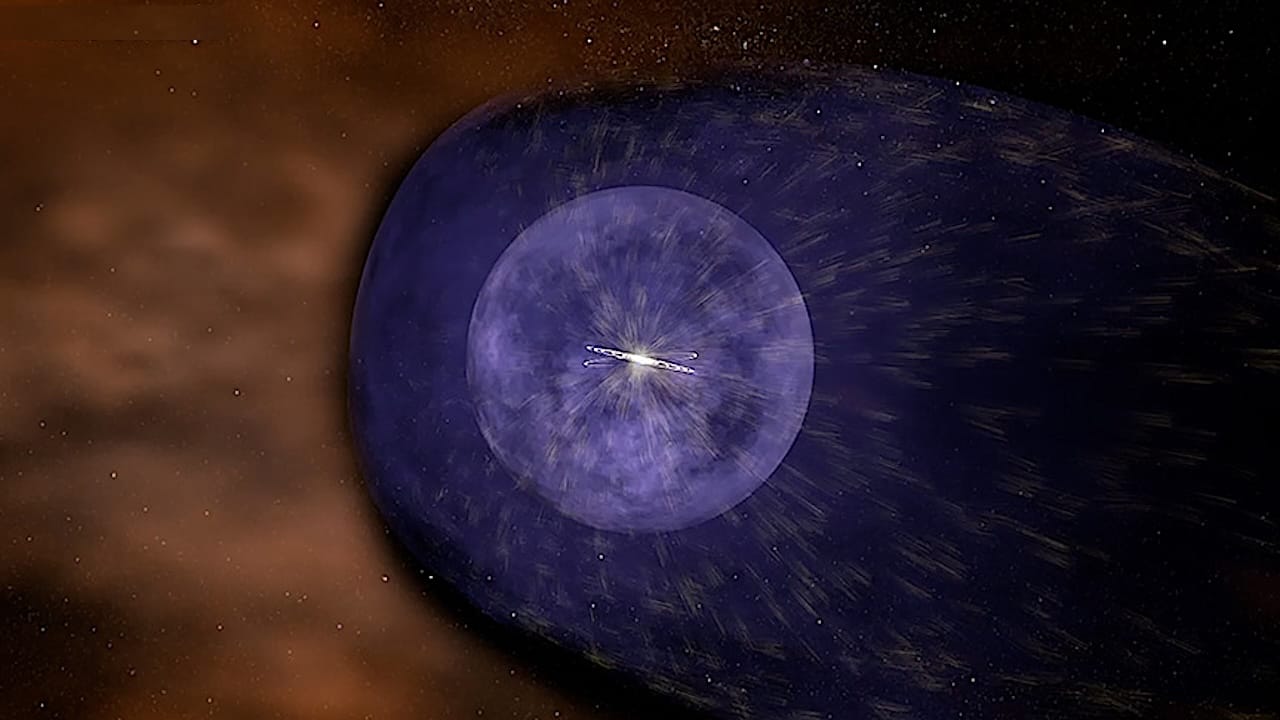
Our Sun might be a calm, middle-aged star today, but billions of years ago, it went through a much more turbulent "childhood." Using NASA’s Chandra X-ray Observatory, astronomers have for the first time captured a young version of the Sun blowing massive bubbles of hot gas into space.
The Astrosphere: A Stellar Shield
As winds blow from a star's surface, they push against the cold galactic gas and dust, creating a protective cavity. Scientists call this an "astrosphere." In our own solar system, we know it as the "heliosphere." This bubble acts as an invisible shield, protecting planets like Earth from damaging interstellar particles.
Meet "The Moth": HD 61005
Located about 120 light-years away, HD 61005 is almost a twin to our Sun in terms of mass and temperature. However, there is a significant age gap: while our Sun is 5 billion years old, HD 61005 is a mere 100 million years old.
When viewed through infrared telescopes, the dust surrounding the star resembles the wings of a moth, leading astronomers to nickname the system "The Moth." These "wings" are made of debris left over from the star's formation, much like our own Kuiper Belt.
Why This Discovery Matters
This observation provides a "time machine" look into our own solar system's past:
- Stronger Stellar Winds: The winds from HD 61005 are 3 times faster and 25 times denser than the current solar wind. This shows us just how aggressive our young Sun used to be.
- A View from the Outside: Since we live inside our heliosphere, we cannot see its overall shape from the outside. Observing HD 61005 helps us understand the evolution and structure of our own protective bubble over billions of years.
- Galactic Environment: The research suggests that our Sun likely passed through much denser regions of gas and dust in the past. If the Sun were in the "Moth's" current neighborhood today, our protective heliosphere would shrink significantly, extending only as far as Saturn's orbit!
The Power of X-rays
Astronomers have been trying to image an astrosphere around a Sun-like star since the 1990s. Chandra detected HD 61005’s bubble because the stellar wind produces X-rays as it slams into the surrounding interstellar material. This massive bubble has a diameter about 200 times the distance between the Earth and the Sun.
Guiding Future Exploration
Beyond understanding the past, this discovery helps us prepare for the future. Understanding stellar winds is crucial for protecting satellites and ensuring the safety of astronauts traveling to the Moon or Mars, as these particles can impact both technology and human health.
Source: NASA/Chandra X-ray Observatory (Astrophysical Journal)